
The reading log and the source defects
Notice pages are edited quietly, and a quotation without a date is worth very little. This page exists so that every claim made on this site can be pinned to a day, and so that the things still wrong in the source are written down rather than tidied away.
Search products
On this page
Nothing on this page is a change history of the service. It is a record of what one reader read, and when.
Log
The reading log
Four entries, two dates, and no invented history. A site that published a list of monthly policy changes it had never witnessed would be doing exactly what this one criticises, so the log starts where the reading started and grows from there.
The notice set was read end to end
Thirteen notice pages and the official tutorial were opened one at a time and captured as screens rather than as text, so that a later disagreement about wording can be settled by looking rather than by remembering. The set covers fees, returns, storage, inspection, insurance, prohibited goods, tracking, delivery attempts, receiving, problems after delivery, fragile goods and aftersales.
Two clauses were promoted to the front of the site
Most of the notices are procedural. Two are not, and both turned out to carry the whole argument of this site: the paragraph that separates what the warehouse verifies from what it will not, and the line under every product gallery that separates the platform from the images and the description above it. Everything else here is read in their light.
The defect register was opened
Seven items, listed further down this page. They are defects in the pages as documents, not in the service the pages describe: a missing number, a stray page reference, a sentence that stops, a duplicated phrase, a company named that is not this one, an inconsistent brand spelling, and one status that has two names.
The site was published
Ten pages, every quotation carrying the date it was read and a link to the page it came from. There is no history before this entry, because this is the first reading. Future entries will record what changed in the source between readings, and corrections to this site will be recorded here with the same dating.
Still open
The clause under watch, and what would change if it moved
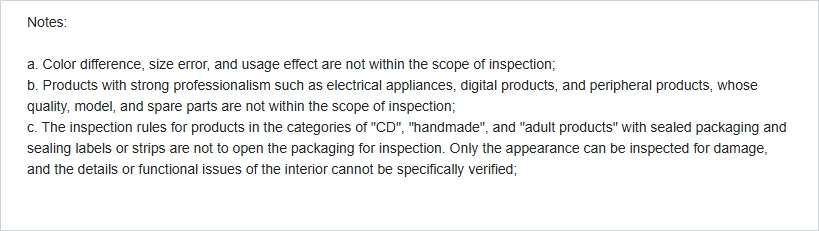
One paragraph governs the worst outcome on this whole site: the warehouse verifies material and category, does not verify authenticity, and assigns the loss to the customer if customs judge the contents counterfeit or sensitive. It is quoted on the home page and again inside the claims page, because the insurance disclaimer excludes the same scenario from the other direction.
Three things about it would be worth an entry in the log above. If the verification list grows, the inspection gets wider and several pages here get less useful. If the assignment of loss moves, the argument of this site changes shape entirely. And if the paragraph simply disappears, that is worth recording too, because a clause being withdrawn is a decision rather than an accident.
Until one of those happens, the reading stands as written and dated. The source page is short and takes a minute to check yourself, which is the honest recommendation for anything on this site that is about to cost you money.
Source excerpt · dated capture

Source excerpt · dated capture
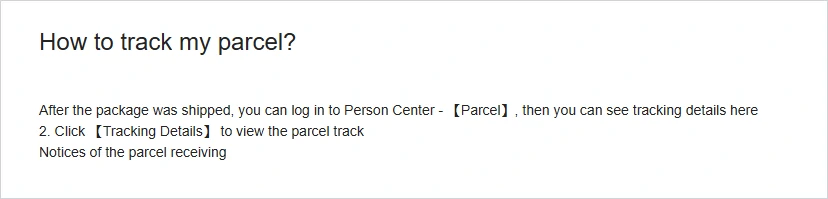
One notice is visibly unfinished, and has been for some time
The page explaining how to follow a shipped parcel is the clearest example of what this register is for. Its first step carries no number. Its second step is numbered two. And the page ends on a heading about parcel receiving with nothing underneath it at all, as though a third section was being pasted in and the paste never finished.
That costs nobody anything directly. What it tells you is how these pages are maintained, which is useful when you are about to rely on a single sentence somewhere else in the set. A page that can end mid-paste can also carry a deadline that was edited in one place and not in another, and this register records one case where exactly that has happened.
The practical habit that follows is dull and cheap. When a sentence in the notices is the only thing standing between you and a loss, open the live page rather than trusting a quotation, including the ones on this site.
The status words are load-bearing, and they are not spelled alike
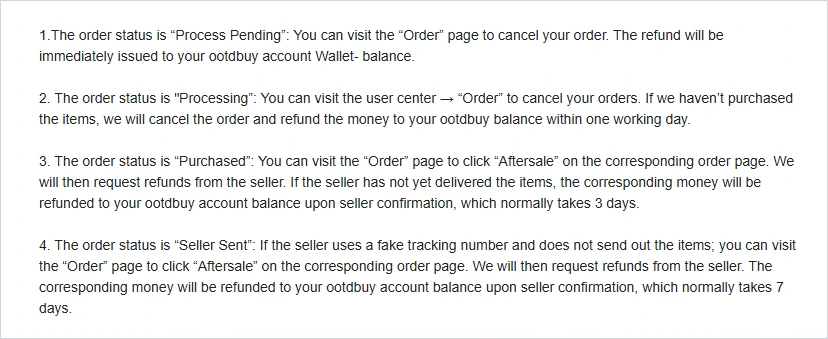
Almost every deadline in the notice set is counted from a status rather than from a date. The aftersale ladder is organised entirely that way: Process Pending, Processing, Purchased, Seller Sent, each with its own refund route and its own owner. Those words are not decoration. They are the index the whole system is sorted by.
Which is why one small thing in the register matters more than the rest of it. The aftersale notice counts its five-day window from an order reaching Stored. The returns notice counts the same window from an order being Stocked in, and is more precise about it, defining five days as one hundred and twenty hours beginning at the next hour after the status changes.
Two names, one rung, one clock. Nothing here suggests the clocks are different, and the returns notice is the one that explains how it runs. But a reader checking a deadline against the wrong page is a reader who can lose a window by searching for a word that is not on it.
Source excerpt · dated capture
The defect register
Seven items, all of them verified by opening the source page rather than by reading somebody else. None of them is a reason to distrust the service, and most are invisible to anybody not reading these pages the way this site does. They are recorded because a register nobody keeps is a register that cannot show a change later.
| Where it is | What is still standing |
|---|---|
| Tracking notice | The first step has no number, the second is numbered two, and the page ends on a heading with no section under it |
| Returns notice | A stray page reference is pasted into the middle of a sentence about cancellation rights, and that sentence then stops before it finishes |
| Returns notice, special standards | The row covering new sneakers repeats a short phrase back to back, run together without a space |
| Notice on problems after delivery | A different company name appears twice in a paragraph about an agency service, in a notice that otherwise names this operator throughout |
| Aftersale notice | The brand is written in lower case where the rest of the notice set uses capitals, in the phrase describing where refunded money lands |
| Storage notice | A sentence about overdue parcels takes the company as its subject, so it reads as though the operator is the thing being given up and destroyed |
| Across two notices | One status has two names. The aftersale notice calls it stored, the returns notice calls it stocked in, and the same five-day window is counted from it in both places |
All seven were present in the pages read on 2026-09-03. The last row is the only one with a practical cost attached, and it is the one worth raising with customer support if you ever find yourself arguing about a window.
Source excerpt · dated capture
How this page is kept
Three rules, stated so they can be held against this site later.
Every quotation carries the date it was read, because an undated quotation from a page that can be edited without announcement is not evidence of anything. Nothing is logged here unless it was seen on the source page, which means this register will always be shorter than the set of things that are actually wrong. And a correction to this site gets an entry of its own rather than a silent edit, on the grounds that a site complaining about quiet edits should not make them.
If you find a clause quoted here that no longer matches the live page, or a reading you think is simply wrong, the address in the footer reaches a person. Corrections are more useful than agreement, and they are published with the date attached and the original wording left visible.
The rest of the site is the reading itself. The questions page is the fastest way in, and the claims page is the one to read before you need it.
Source excerpt · dated capture
