What the warehouse checks, and what you check
Photographs arrive, the status changes, and it feels like somebody has vouched for the thing in the box. The notice that governs that moment says something more modest, and it says it in one paragraph that is worth reading twice.
Search products
On this page
Every quotation below was read on the operator notice pages on 2026-09-03 and is linked to its source.
The scope
What the warehouse states it will verify
The instruction covering receipt and storage is a single paragraph. It commits the warehouse to verifying quantity, colour, size and other specifications; to removing the original courier box; to repacking into the operator's own self-sealing bags; and to putting the result into storage. Fragile, easily damaged and oversized goods keep their original boxes instead.
Two practical things follow from that paragraph and neither is obvious. The first is that the outer box you might have wanted kept, the one with the shop's printing on it, is removed by default. If it matters to you, say so in the message field before the purchase is made, because nobody is going to ask.
The second is the word specifications. Verifying that a thing matches the specification you ordered is a comparison against a line of text. It is not a judgement about whether the thing is any good, and the notes printed underneath this paragraph make that explicit.
Source excerpt · dated capture

QC, GL and RL, and the word that actually matters
Three abbreviations do most of the talking in buyer forums, and none of them appears anywhere in the notices read for this site. That mismatch causes real confusion, because people ask customer service about a GL and get an answer about something else. Here is the translation, plus the one word the operator does use.
| Term | What it means, and where it comes from |
|---|---|
| QC | Quality check. Community shorthand for the photographs taken after the warehouse receives an item. The notices call this inspection, and define its scope narrowly |
| GL | Green light. Forum shorthand for looking at those photographs and letting the item ship. In the interface this is simply submitting the parcel |
| RL | Red light. Forum shorthand for rejecting the photographs and asking for it to go back. In the interface this is an aftersale request against the order |
| Stored | The operator's own status word, and the only one of the four with a clock attached to it. Two separate deadlines are counted from the moment an order reaches it |
QC, GL and RL are buyer vocabulary rather than operator vocabulary. Use them with other shoppers; use the operator's own words when you open a ticket.
Cancellation-status vocabulary belongs to the aftersale status ladder; QC, GL and RL above are community shorthand.
The exclusions
Three exclusions, and the boxes that are never opened
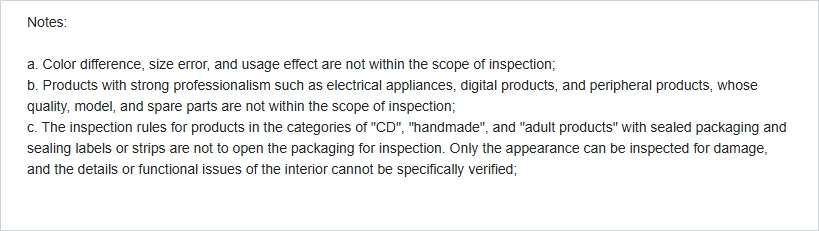
Directly beneath the scope paragraph sits a short list of notes, and it is the most useful thing on the whole notice. Note (a) states that colour difference, size error and usage effect fall outside the scope of inspection. Note (b) puts electrical goods, digital products and their peripherals outside it as well, on the grounds of specialism: quality, model and spare parts are not checked. Note (c) covers sealed categories, naming CDs, handmade goods and adult products, where the packaging is not opened at all and only the outside can be examined for damage.
Read that list against what people actually worry about and the overlap is almost total. Does the colour match the photograph is (a). Does it fit is (a). Does the electronic thing work is (b). Is the sealed item complete inside is (c).
None of this is hidden and none of it is unusual for a forwarding warehouse. It is simply the opposite of what the word inspected suggests to somebody reading it for the first time, and it is the reason the photographs are worth studying yourself rather than treated as a verdict somebody else has already reached.
Source excerpt · dated capture
How to read the QC photographs, given what the scope leaves out
The photographs arrive with that scope already applied, so reading them well means reading for the things nobody downstream is contracted to catch. Everything in note (a) is now your job, and this is the only look you get while the item is still in a country where sending it back is cheap.
Start with the four things the warehouse did check, because they are the quickest to confirm and the cleanest to raise. Count the items. Compare the colour against the variant name you submitted rather than against the listing photograph. Find the size label and read it. Check the specification against what you ordered. A mismatch here is an easy case to make, because it is a mismatch against a line of text rather than a matter of opinion.
Then look for what the scope excludes, since nothing else will. Stitching and glue along the sole and the seams. Logos and lettering, which photograph well enough to compare against a retail picture you find for yourself. Hardware: zips, buttons, clasps. The inside of a garment, where the care label and the construction are. If something is hidden behind a bad angle, ask for another frame rather than deciding from the one you were given, and ask while the order is still sitting at the Stored status, because that is where the clock in the next section starts.
Keep the expectation honest, though. These are photographs taken quickly on a warehouse table, not a bench inspection. They are good at catching the wrong thing in the box and bad at settling anything subtle, which is the same limit the notice describes in its own words.
- Quantity
- Count what is in the frame against your order.
- Variant
- Compare the colour with the variant name you submitted.
- Size label
- Read the label and compare it with the seller measurements.
- Hidden details
- Ask for another frame when seams, hardware or labels cannot be seen.
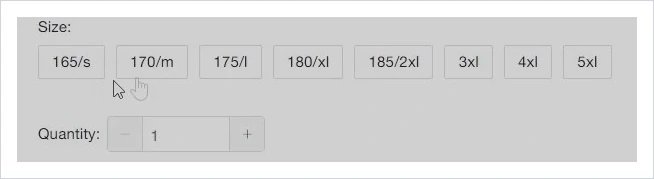
Listing reference, rather than a QC photograph: view the size and quantity controls.
This records your own review. It does not verify authenticity, approve an item or guarantee delivery. The checklist resets when you reload this page.
Source excerpt · dated capture
Your own check happens the moment the status turns
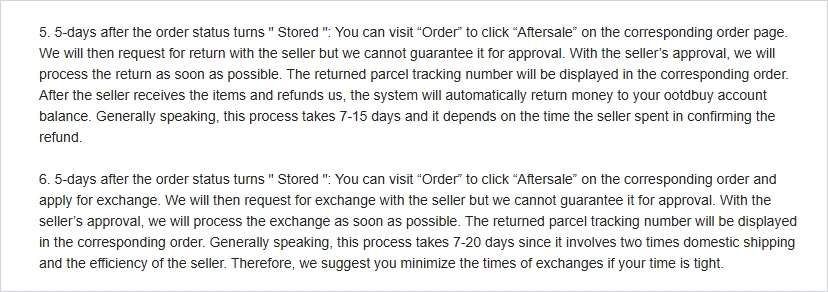
The aftersale notice counts its windows from the order status reaching Stored, and that is the same moment the inspection photographs appear. So the photographs are not a souvenir. They are the evidence you get to look at while a clock runs.
The wording of those two paragraphs deserves a mention. Both open with the same construction, five days and the Stored status, and on their own neither says whether five days is a window opening or a deadline closing. The answer does exist, but it is on a different page: the returns notice defines the guarantee as running within five days of the product being stocked in the warehouse. One clock, two notices, and the one you would open for this purpose is not the one that says which way it runs.
What is clear is the shape of the process: a request goes to the seller, approval is not guaranteed, and the whole thing depends on somebody else's willingness. The notice says so in plain words.
Storage is the second clock, and it runs quietly
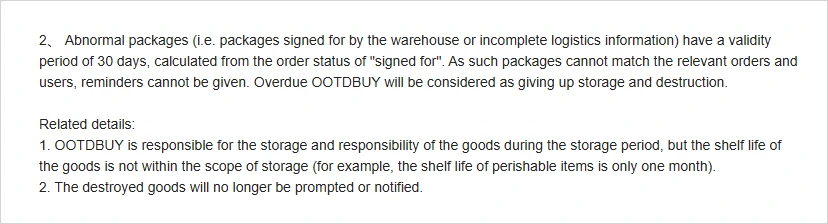
An item sitting in the warehouse is sitting inside a validity period. The storage notice gives normal packages one length and abnormal packages a much shorter one, counted from the point the warehouse signed for them, where abnormal means the logistics information was incomplete or the parcel could not be matched to an order.
Then comes the sentence that makes this worth a section of its own. For those unmatched packages, the notice states that reminders cannot be given, because the system does not know whose they are. And at the end of the related details it states that destroyed goods will no longer be prompted or notified.
Put plainly: the category of parcel most likely to be lost is also the category the operator has told you in advance it cannot warn you about. The defence is entirely on your side of the line, and it is dull. Check that every purchase has actually landed under your account, and do it while the item is still somewhere. The storage notice is short, and it is one of the few worth reading in full before anything goes wrong.
Source excerpt · dated capture
The last inspection is the one you do at the door
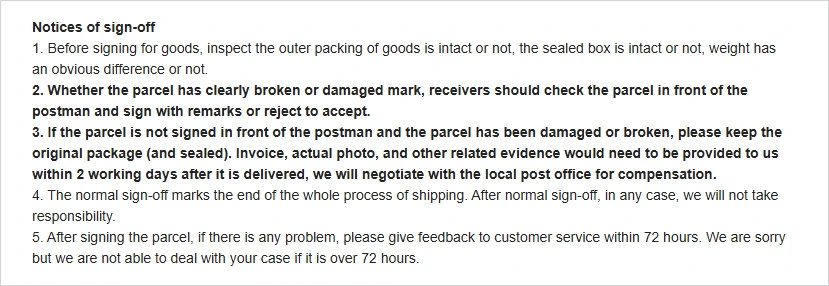
The sign-off section is a five-item list, and the first three items are genuinely good advice: look at the outer packing before you sign, notice whether the seal is intact, notice whether the weight is obviously different. If there is visible damage, check the parcel in front of the courier and either sign with remarks or refuse it outright.
Item three tells you what to do if you already signed and then found damage: keep the original packaging sealed, and get the invoice, the photographs and the rest of the evidence to customer service within two working days, at which point the operator says it will negotiate with the local post office.
Items four and five are the ones that close the file, and they are the subject of the claims page. What belongs here is the practical point: the two working days start at delivery, not at the moment you get round to opening the box.
Source excerpt · dated capture
The order these checks happen in
Four checks, four owners. The warehouse verifies the order against the specification and photographs the result. You read those photographs, while a clock runs that starts at the Stored status. The storage period runs underneath both of those, quietly, and ends in destruction without a reminder if nothing is done. And at the far end, at your own front door, you get one last look before a signature ends the process.
Three of the four are yours. That is not a complaint about the service; it is what a forwarding warehouse is. The notices say so consistently and in several different places, which is more than many operators manage.
What the checks cannot tell you is what happens when a parcel never arrives at all, or arrives with the wrong contents, or is taken at the border. Those are governed by a different set of clauses, and they are read on the shipping page and the claims page.
- WarehouseVerify the specificationCompare the received item with the order and photograph it.
- YouRead the photographsReview the visible details while the Stored clock runs.
- YouWatch storageKeep the parcel matched to your account and track its storage period.
- YouInspect on arrivalCheck the outer parcel before signing and keep the evidence.
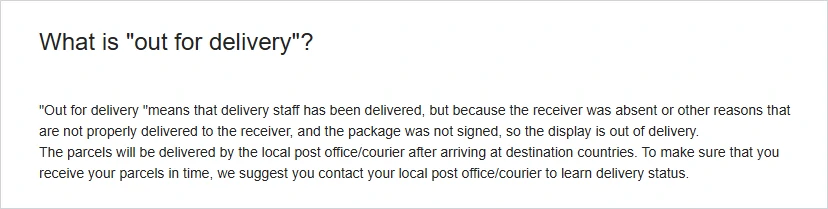
Delivery wording is a separate question: read what “out for delivery” means, or view the original notice.