When something goes wrong, start with the evidence
Compensation reads like one subject and behaves like four. Cancelling before purchase, recovering money from a seller, claiming against insurance and arguing about a delivery are governed by different paragraphs with different owners.
Search products
On this page
Everything below is quoted or paraphrased from operator notice pages read on 2026-09-03, each linked to its source.
The ladder
The remedy changes hands as the order climbs
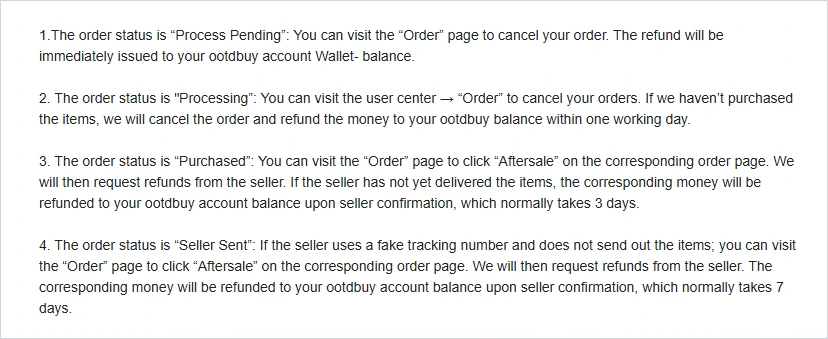
The aftersale notice is organised by order status, and read straight through it tells a story nobody wrote down deliberately. At Process Pending you cancel and the refund is issued immediately to the wallet. At Processing you cancel, and if the purchase has not yet been made the money comes back within a working day. Two rungs up, at Purchased, the language changes: the operator will request a refund from the seller, and the money returns upon seller confirmation. At Seller Sent, including the case the notice names outright, where a seller has used a fake tracking number and shipped nothing, it is the same shape again. A request. A confirmation. Somebody else's decision.
By the time an item has reached the warehouse, the notice says plainly that approval cannot be guaranteed.
So the ladder is not a list of procedures. It is a map of how fast your own leverage evaporates, and the practical conclusion is unglamorous: the cheapest moment to change your mind about an order is always earlier than you think it is.
Source excerpt · dated capture
Source excerpt · dated capture
Fragile goods are guaranteed up to the moment they leave
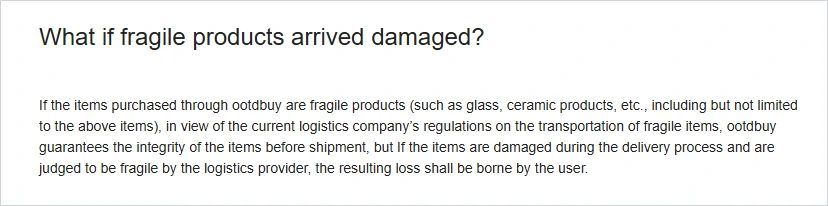
Glass, ceramics and anything like them get a notice of their own, and it is a model of precise drafting. The operator guarantees the integrity of the items before shipment. If they are damaged during delivery and the logistics provider judges them fragile, the resulting loss is borne by the user.
Both halves are reasonable in isolation. A warehouse can sensibly promise that what it packed was intact, and it cannot sensibly promise what an airline will do to a box. Put the two halves in one sentence, though, and the guarantee covers exactly the period during which nothing much can go wrong.
The exemption clause elsewhere in the notices says the same thing from the other end: for fragile goods, only loss can be claimed, not damage. Two separate pages, one position, stated consistently.
Evidence
A claim is a photograph problem before it is an argument
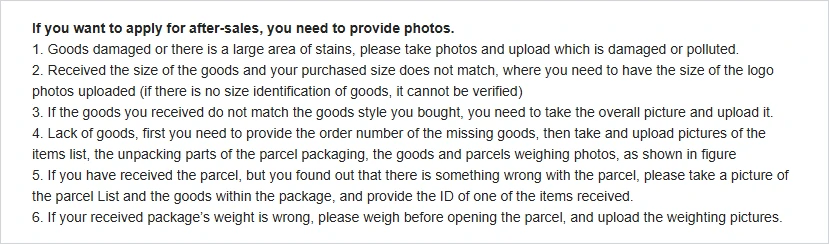
The notice about problems found after delivery contains the most operationally useful list on the whole site: six numbered situations and the photographs each one requires. Damage or staining wants pictures of the damage. A size mismatch wants the size label, and the notice adds that where no size marking exists on the goods, it cannot be verified at all. A wrong style wants an overall picture. Missing goods want the order number of what is missing, plus the item list, the opened packaging and the weighing photographs. A wrong weight wants the parcel weighed before it is opened.
That last one is the reason to read this list in advance rather than at the moment you need it. Once a box is open, the photograph the notice asks for no longer exists and cannot be recreated. The same applies to the packaging in the missing goods case.
So the practical advice is dull and it works: before you cut anything, weigh the box and photograph the reading, photograph the sealed parcel, then open it on camera. Ninety seconds, and it is the difference between a claim that has evidence and one that has a story. The list is short enough to read in full.
Source excerpt · dated capture
The insurance disclaimer, and the item that swallows the rest
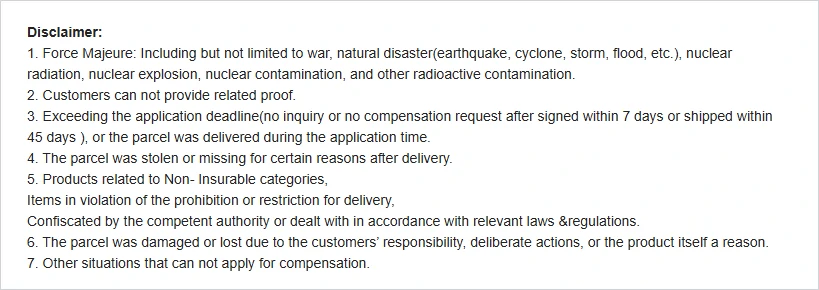
Insurance bought at parcel submission arrives with a seven item disclaimer, and most of it is unsurprising: force majeure, missing proof, situations after delivery, the customer's own responsibility.
Item five is the one worth your attention, because it is where the two halves of this site meet. It excludes products in non-insurable categories, items violating the prohibition or restriction for delivery, and anything confiscated by the competent authority or dealt with under the relevant laws. In other words, the scenario that the restricted list describes and the one the confiscation clause assigns to you is also the scenario insurance is written not to cover.
Item three is the quiet one: no inquiry or compensation request after 7 days from signing, or 45 days from shipping. Those are the outer walls of the whole claims process, and they are stated once, in a list nobody opens.
Source excerpt · dated capture
The exemptions
Six exemption clauses, read as one instruction
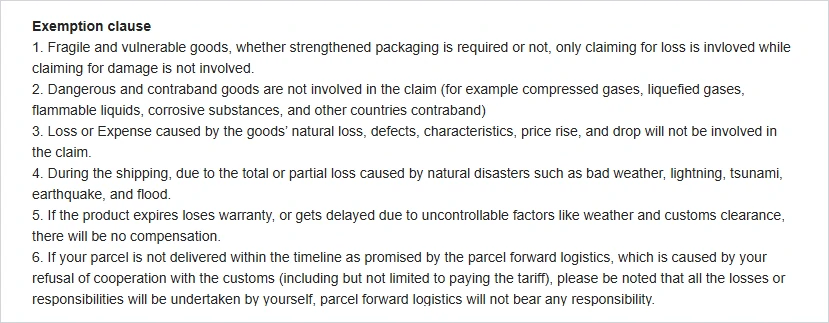
The exemption clause is the densest paragraph in the notices and the one most worth reading before anything goes wrong. Fragile goods: loss only, never damage. Dangerous and contraband goods: outside the claim entirely. Natural loss, defects, characteristics and price movement: excluded. Total or partial loss from weather, lightning, tsunami, earthquake or flood: excluded. Expiry, lost warranty or delay caused by weather and customs clearance: no compensation.
Then item six, which is different in kind from the other five. If the parcel is not delivered on time because you refused to cooperate with customs, including but not limited to paying the tariff, every loss is yours and the forwarder bears none of it.
That clause is not about disasters. It is about a decision you might make in a bad mood on a Tuesday, when a customs charge arrives that feels unfair and ignoring it looks like an option. The notice is explicit that it is not.
Source excerpt · dated capture
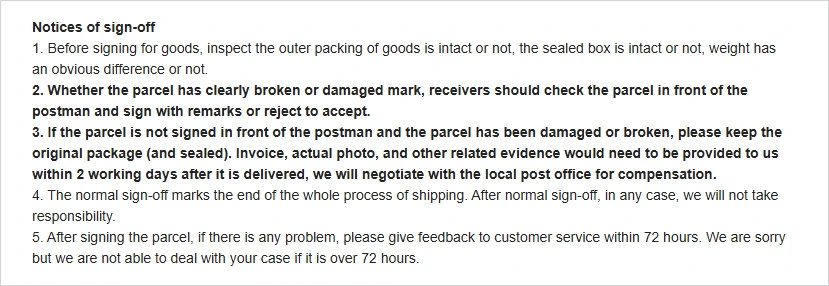
Every deadline in the notices, on one screen
Scattered across five separate notice pages are six clocks. Nobody will remind you about any of them, and three of them are already running by the time a problem becomes visible.
| Moment | What the notices give you |
|---|---|
| At the door, before signing | Inspect the outer packing, the seal and the weight. Sign with remarks or refuse to accept |
| Damage found after signing | Keep the packaging sealed and provide the invoice, photos and evidence within 2 working days of delivery |
| Any other problem after signing | Feedback to customer service within 72 hours. The notice says it is not able to deal with a case after that |
| Insurance claim | No inquiry or compensation request more than 7 days after signing, or 45 days after shipping |
| Return or exchange | Tied to 5 days and the Stored status, in wording that does not say whether the window is opening or closing |
| Storage | A validity period ending in destruction. Abnormal parcels get the short one, and the notice states that reminders cannot be given |
Compiled from the notices on receiving, problems after delivery, insurance, aftersales and storage, all read 2026-09-03. Deadlines change; check the live pages when one of these actually matters.
Source excerpt · dated capture

What to do with all of this
Three habits cover almost every case, and none of them requires reading a notice in the moment.
Decide early, because the status ladder only takes leverage away. Photograph before you open, because two of the six claim situations ask for a picture that stops existing once the box is cut. And treat the day of delivery as the day the clock starts, not the day you get round to it, since the two tightest deadlines in the whole system are both counted from signature rather than from discovery.
Everything else on this site is background. If you only take one page away, take this one, and take it before you need it rather than after. The questions page gives the same material in short form, one answer per clause.
Source excerpt · dated capture