
Read the shipping rules before the parcel leaves
Once a parcel leaves the warehouse it is in the hands of a carrier, a customs authority and a local postal service, none of which has any contract with you. The notices are unusually frank about that. What they are not is reassuring.
Search products
On this page
Four clauses and one screenshot of a clock, all read on operator pages and linked to their sources.
Restricted
The restricted list, and the one entry that is not about physics
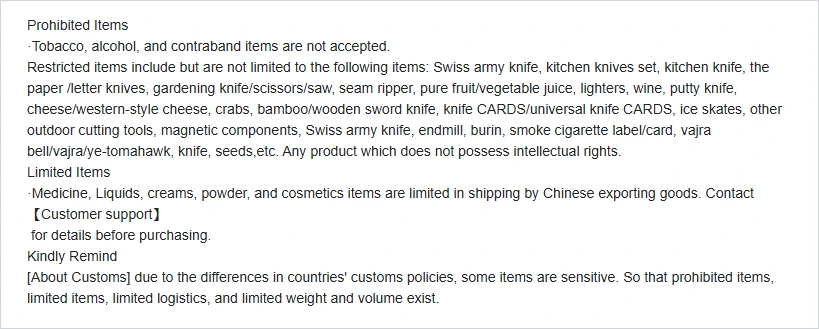
The prohibited items notice opens with the expected line about tobacco, alcohol and contraband, then runs a long restricted list that reads like an inventory of a hardware shop: knives of every description, lighters, saws, seam rippers, ice skates, magnetic components, seeds. Almost every entry has an obvious physical reason for being there. Air freight does not like blades, flames, magnets or living things.
Then the list ends, after an "etc.", with a clause that belongs to a different category of thought entirely: any product which does not possess intellectual rights.
That is not a transport restriction. It is a legal one, and it is the single broadest sentence on the page, sitting at the end of a list of kitchen knives where nobody is reading carefully any more. It is also the clause with a matching consequence elsewhere in the notices, which is what makes it worth pointing at.
Source excerpt · dated capture
Source excerpt · dated capture
Out for delivery is defined, and not the way you would guess
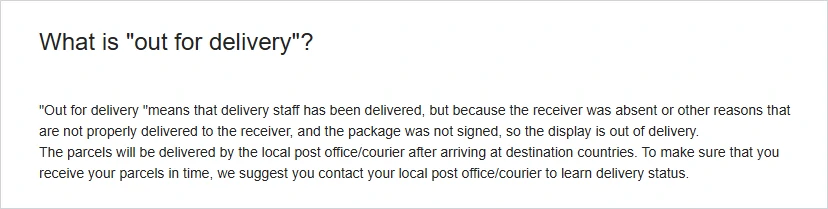
Most carriers use out for delivery to mean the parcel is on a van today. The operator publishes its own definition, and it describes the opposite situation: delivery staff attended, the receiver was absent or the parcel could not properly be handed over, nothing was signed, and so the status displays as out of delivery.
If that definition is the one your tracking page is using, seeing it is not good news arriving early. It is a failed attempt, and the parcel is sitting somewhere waiting for you to do something about it.
The same paragraph adds the part that matters operationally: after arrival in the destination country the parcel belongs to the local post office or courier, and the operator's suggestion is to contact them directly. Read the definition in full before you need it.
Insurance is a line item, bought at the moment of submission
When a parcel is submitted, a strip near the payment area offers insurance: a declared value, a cost, and a checkbox. It is easy to miss and it is the only moment it is offered.
The decision is worth making deliberately rather than by default, in both directions. An uninsured parcel is a choice to carry the whole exposure yourself. An insured one is not a guarantee of payment either, because the insurance notice attaches its own list of situations it does not cover, and that list is long enough to deserve the separate reading it gets on the claims page.
What the strip does tell you honestly is that insurance is priced separately from freight. It is not folded into the shipping quote, it does not appear unless you tick it, and it shows up again as its own line when the parcel is finally settled.
Source excerpt · dated capture

The tracking notice is two lines long and stops mid-sentence
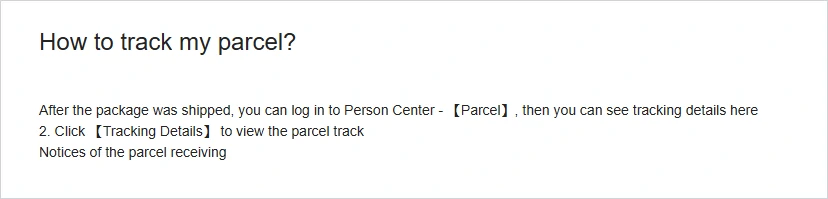
Tracking, once a parcel has shipped, lives in the account under the parcel section, and the notice explaining it is short enough to quote almost entirely. It is also a small monument to how these pages get maintained.
The first step has no number. The second step is numbered two. And then the page ends on a heading, Notices of the parcel receiving, with nothing underneath it at all, as though somebody was pasting a third section in and stopped.
None of that costs you money, and it is not a reason to distrust the service. It is a reason to treat the notices as working documents rather than as a contract drafted by somebody who read it afterwards. When a sentence in them is the only thing standing between you and a loss, check it against the live page rather than against your memory of it.
Source excerpt · dated capture
Three tiers, and what each one asks of you
The restricted goods notice sorts its content into three headings and they are not variations of one another. Each carries a different instruction, and only the first is absolute.
| Heading in the notice | What it actually asks of you |
|---|---|
| Prohibited items | Do not buy them at all. Tobacco, alcohol and contraband are stated as not accepted, full stop |
| Restricted items | A long list, explicitly not exhaustive, of things that cannot go by air. If your item resembles anything on it, assume it is covered |
| Limited items | Medicine, liquids, creams, powders and cosmetics are limited by Chinese export rules. The notice tells you to contact customer support before purchasing, which means before the money is spent |
| Kindly remind, about customs | Destination policy varies, so prohibited, limited and weight or volume limits exist beyond the ones listed. This is the notice telling you the list is not the whole story |
Paraphrased from the prohibited items notice, read 2026-09-03. The wording is the operator's; the second column is this site's reading.
The original notice is shown in the restricted goods section above.
The clock
Source excerpt · dated capture

Every deadline in the notices is counted on somebody else's clock
The operator prints a live Beijing timestamp in its own site chrome, directly under the logo, where most services put a tagline. It is a small thing and it is the most quietly useful detail on the whole interface.
Count the deadlines scattered through the notices: two working days to provide evidence after a damaged delivery, seventy-two hours to raise a problem after signing, five days tied to the Stored status, storage periods counted in weeks and months. Every one of them is administered by people working to the clock in that header, not to yours.
The notices do not state which timezone their deadlines use, so this site will not claim to know. What it will say is that a parcel delivered on a Friday evening in western Europe has less slack in it than the number suggests, and that the safe assumption when you are close to a limit is the operator's clock rather than your own.
The broadest sentence on the restricted list
Six words at the end of a list of knives, after an "etc.", with no heading of its own and no explanation attached. Read literally it covers a great deal more than the list it is appended to, and it is the only entry there whose reason is not something an aircraft would object to.
Any product which does not possess intellectual rights.
Prohibited items notice, end of the restricted list, read 2026-09-03
This site does not tell anyone what to buy. It points out that the sentence exists, that it sits in the quietest possible position on the page, and that the consequence attached to it elsewhere in the notices is total loss of the parcel with the cost on you. The claims page reads that consequence clause by clause.
Source excerpt · dated capture
