
From a product link to your front door
A buying agent is a purchasing desk plus a warehouse. You send a link, somebody buys the thing in mainland China, it is received and stored under your account, and when you are ready it is packed and flown out. Four screens govern that, and none of them is the one people spend their time on.
Search products
On this page
One screen at a time
Source excerpt · dated capture
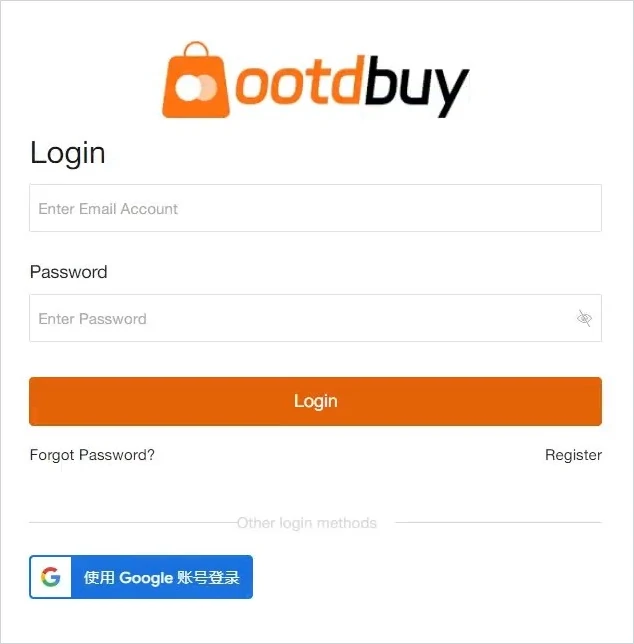
Everything hangs off the account, including the evidence
The sign-in screen is unremarkable and worth one minute of attention anyway, because the account is not merely a login. It is the only place where the order, the warehouse photographs, the parcel and the correspondence exist in one thread. Claims later in this site all depend on being able to point at that thread.
One small detail on the screen says something about how the service is built: the alternative sign-in button is labelled in Chinese while the rest of the interface is in English. It is a translation gap in a mainland-facing product that has been dressed for an international audience, and the same gap shows up in the notices, where whole paragraphs read as if pasted from elsewhere.
Use an address you will still control in a year. Storage and claim deadlines are both counted in days, and both are announced by email.
The message box is the only place you get to give instructions
When a purchase request is submitted there is a free text field attached to it, with a character counter, addressed to whoever will place the order. It is the one point in the whole flow where your words travel with the order rather than around it.
Most people leave it empty. It is the right place for the things the listing cannot express: which variant you actually meant when the seller has named two of them almost identically, whether you want the shop packaging kept, whether a substitute is acceptable if the size is gone. The official tutorial also mentions reaching the buyer through the order enquiry thread afterwards, but a note written before the purchase is read before the money is spent, and one written after is not.
Keep it short and specific. It is read by somebody working through a queue, in a second language, against a clock.
Source excerpt · dated capture

The fee notice draws a boundary, then names what sits inside it
The service and fees notice does something useful in its opening lines: it states that nothing will be charged beyond the goods, the international shipping and the customs declaration, with optional extras purchased as needed. Then it defines the cost of goods as the item price plus the domestic freight to the warehouse.
That second definition is the one that surprises people. The leg from the seller to the warehouse is part of the goods cost, not part of the shipping cost, and a listing advertised with free domestic delivery has simply folded that leg into its price. It also explains a line in the returns notice: even where a seller shipped free, the first dispatch is recovered if you send something back.
International freight is quoted by weight, method and destination, so it is not knowable at the moment you order. The customs declaration line is stated separately and varies by shipping method.
Source excerpt · dated capture
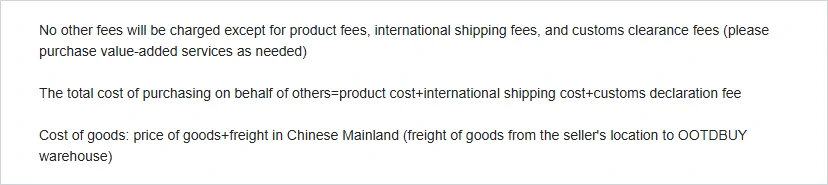
Where money settles
The one screen where a number stops being an estimate
International freight is a deposit first and a settlement later. You pay an estimate when the parcel is submitted, the carrier assesses the packed box, and the difference goes back or is collected. The official tutorial says as much in its step on confirming the freight: the carrier-assessed volume and weight decide, and the balance moves either way.
The settlement panel is where that arithmetic becomes visible. Compensation, actual shipping, discount, insurance and the prepaid deposit are listed as separate lines, and the final figure at the bottom can be negative, which simply means the deposit overshot and money is coming back to the wallet rather than leaving it.
Two things are worth taking from the screen. The insurance line is a line item on this panel, so the decision to insure is priced here and not hidden in the freight. And the unpacking request button sits next to the payment button, which is the last moment that choice is available before the box is closed.
Source excerpt · dated capture
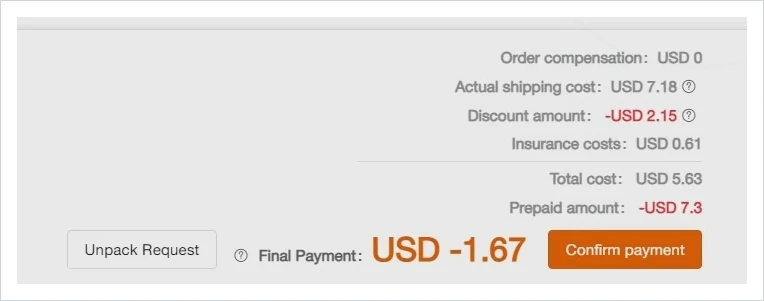
The official ten steps, and who decides at each one
The operator publishes a ten step tutorial covering the flow from choosing an item to signing for the parcel. The steps themselves are uncontroversial. The column worth reading is the second one.
| Stage | Who is deciding |
|---|---|
| Choose an item | You, from the source platform or the catalogue |
| Submit the purchase request | You, and the message box travels with it |
| Pay for the goods | You, by card, transfer or the payment methods the operator lists |
| The purchase is placed | The buying desk, working from your link and your note |
| Receipt and inspection | The warehouse, within a scope defined in the notices and narrower than most people assume |
| Submit the parcel | You, choosing the carrier and any extra services |
| Pay the freight deposit | You, against an estimate rather than a measurement |
| Confirm the freight | The carrier, by assessing the packed box |
| Dispatch | The carrier, and tracking begins from the warehouse |
| Sign for it | You, and that signature is the end of the file |
The stages are the operator's. The second column is this site's reading, drawn from the tutorial and the notices linked throughout this page.
Source excerpt · dated capture
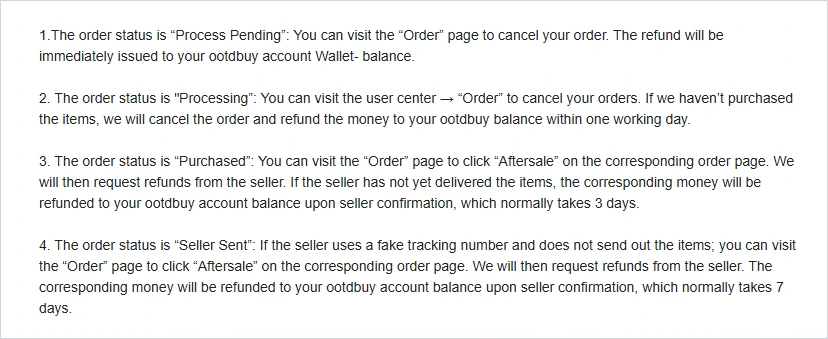
The sentence that defines what you are being charged for
Read the fee notice for the boundary it draws rather than for the amounts it names, because the amounts move and the boundary does not. Three headings, and a note that anything else is optional and bought deliberately.
No other fees will be charged except for product fees, international shipping fees, and customs clearance fees (please purchase value-added services as needed).
Service and fees notice, opening line, read 2026-09-03
This site does not reproduce any figure from the fee notice. Rates change without announcement, and a stale number in a guide is worse than no number, because it gets quoted back. Read the amounts on the operator pages, on the day you need them, and use this site for the structure instead. What that structure costs you in practice depends on decisions taken earlier, which is the subject of the picking page.
Source excerpt · dated capture
