OOTDBuy Spreadsheet: the small print
Find products, then check OOTDBuy's inspection, return and shipping rules before you order.
Search products
Browse by category
Choose a category, then read its rule before ordering.
16 categories
No matching category
Try a broader category name, change the group or use Reset to see every category.
 SneakersThe security tag is a condition of its own in the returns clause.
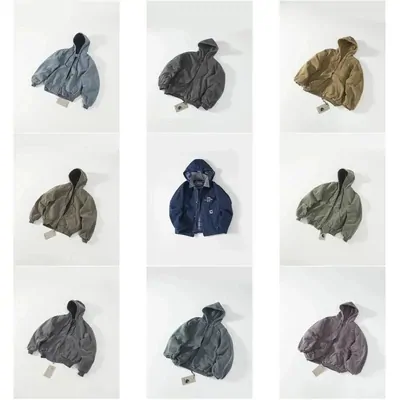 Jackets & CoatsThe shop carton is not what ships.
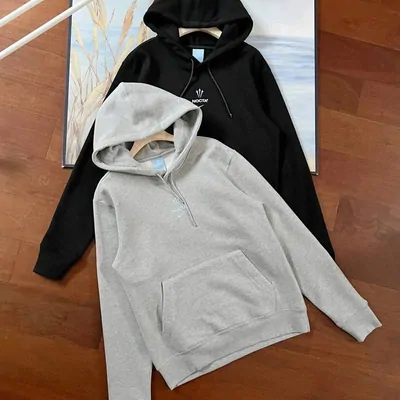 HoodiesColour difference is named as outside the inspection scope.
 T-ShirtsAsk for the tags to come off and the returns clause stops applying.
 JeansSize deviation is outside the inspection scope as well.
 SweatpantsUse effect sits outside the scope too, and that is the phrase covering how a thing wears once you have it..
 WomenswearThere is no separate rulebook for this section.
 JerseysIf a print comes back wrong, the claim runs on photographs, and the clause names which ones it wants..
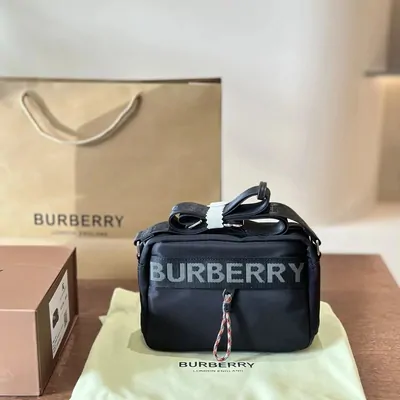 BagsInspection reports on the parcel in front of it.
 HatsThe clauses are written about contents, not about packaging.
 BeltsLeather goods get the same short inspection as everything else.
 EyewearThis is where the fragile clause lands, and that clause is written narrowly enough to be worth reading first..
 PerfumeA sealed bottle is not opened at the warehouse.
 JewellerySmall does not mean different.
 WatchesThe restricted list names components, not products.
 ElectronicsThese are inspected for damage only.
Every card opens the matching category in the catalogue. The note under each one says which clause that kind of thing runs into, not how nice it looks.
Pivot
The most expensive clause is the one about authenticity
Start with the paragraph that decides the worst case, because it is the one people find out about last. It sits inside the notice about receiving a parcel, under a heading of its own, and it does two separate things in four lines.
First it draws the limit of the inspection: the warehouse will check what a thing is made of and what category it falls into, and will not form a view on whether it is genuine. Second it assigns the consequence: if customs judge the contents to be counterfeit or sensitive and take the parcel, the loss is yours.
Those two halves are usually read apart. Read together they say something precise, and worth knowing before the first order rather than after a seizure: nobody in the chain is checking the thing you are most worried about, and nobody in the chain carries the cost if the answer turns out badly. The clause closes by suggesting you choose the shipping method carefully, which is the only piece of advice it offers.
Source excerpt · dated capture

Source excerpt · dated capture
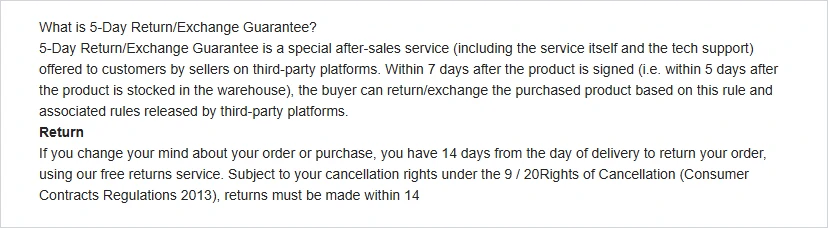
Two return windows, published one under the other
The returns notice opens by defining a guarantee counted in days from the moment stock lands in the warehouse. Directly underneath, in the same block of text, sits a second paragraph written for a different jurisdiction, counting a longer window from the day of delivery and citing consumer regulations by name.
The two are not variants of one rule. They start their clocks at different events, run for different lengths, and were plainly written by different hands. One of them even carries a stray page number from whatever document it was pasted out of.
The practical reading is the short one: the window the operator actually administers is the warehouse one, and that is the clock worth watching. The longer paragraph is a good reminder that a notice page can carry more than one rule at a time.
What the front page says, and what the notices say
The operator states its case in four words on its own home page: scale, price, service, speed. There is nothing wrong with any of them, and two are straightforwardly checkable. What they are not is a description of liability.
A promise about response time tells you how quickly someone will read your message. It does not tell you what the answer is allowed to be, and the answer is governed elsewhere, in pages most people never open.
That gap is not a scandal. It is how every service on earth is written, and the operator has at least published both halves under its own name. This site simply reads the half that is quieter, and treats the loud half as context rather than as an argument.
Source excerpt · dated capture

The list of requests that are refused before they are read
A separate notice, the one about problems found after delivery, carries a numbered list of situations in which a return request will not be accepted at all. Replaced or altered goods. Opened items in categories where opening destroys resale. Missing proof of purchase. Anything raised after the feedback deadline.
It is worth reading the list as a set of instructions rather than as a warning, because that is what it is. Three of the four entries are things you control in the first hour after the box arrives: do not open what you might send back, keep the paper that came with it, and raise the problem while the clock is still running.
The fourth, proof of purchase, is the one people lose, because the purchase was made by somebody else on your behalf.
Source excerpt · dated capture

One sentence closes the whole file
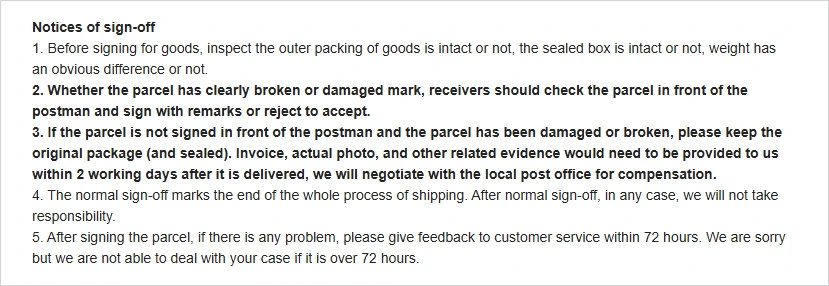
Buried in the section on signing for a parcel, fourth in a list of five, after three items of sensible advice about checking the seal and the weight in front of the courier, is the sentence that ends the process. It is not highlighted. It reads like housekeeping. It is the single most consequential line on the notice pages.
The normal sign-off marks the end of the whole process of shipping. After normal sign-off, in any case, we will not take responsibility.
Notices of the parcel receiving, section on sign-off, read 2026-09-03
Everything this site has to say about claims, damage and compensation happens before that sentence takes effect. After it, there is no file to reopen. That is why the claims page is organised around deadlines rather than around arguments.
Source excerpt · dated capture
Where each clause is read on this site
Nine pages, each built around the notices that govern one stage. Nothing here is a summary of the operator's marketing; every page quotes the source text and links to the page it came from, so you can disagree with the reading without having to take my word for the wording.
| Page | The clauses it reads |
|---|---|
| Spreadsheet | What a category listing does and does not commit to, and the disclaimer printed under the product images |
| How it works | The ten official steps, the deposit, and the moment a balance is settled rather than estimated |
| QC checks | The inspection scope, the three exclusions inside it, and the categories that are never opened |
| Shipping | The restricted list, customs handling, storage limits and what out for delivery is defined to mean |
| Claims | Exemptions, the insurance disclaimer, the photographs a claim must carry, and the deadlines around it |
| Buying advice | How the operator itself describes the three source platforms, and what that implies about seller choice |
| FAQ | Short answers, each one attached to the clause it comes from rather than to an opinion |
| Updates | What changed in the notices, and the defects still standing in them |
| About | Who reads these pages, how they are checked, and what this site earns |
Every quotation on this site is dated. The operator can edit a notice at any time and is under no obligation to announce it, so a quotation without a date is worth very little.
Source excerpt · dated capture