Choose a listing, a seller and an agent carefully
Most buying advice comes from people selling something. This page is built on the exception: a paragraph inside the operator's own tutorial that tells its users to be careful about the source platform they are most likely to use.
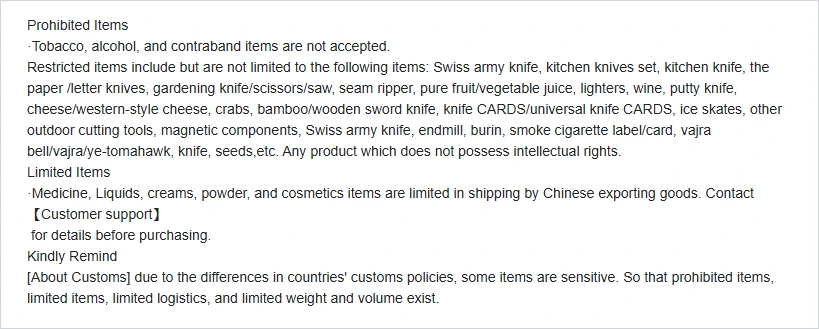
Search products
On this page
The comparison below is paraphrased from the official tutorial, read 2026-09-03 and linked at the end of the section.
Sources
Three platforms, and the operator rates them unevenly
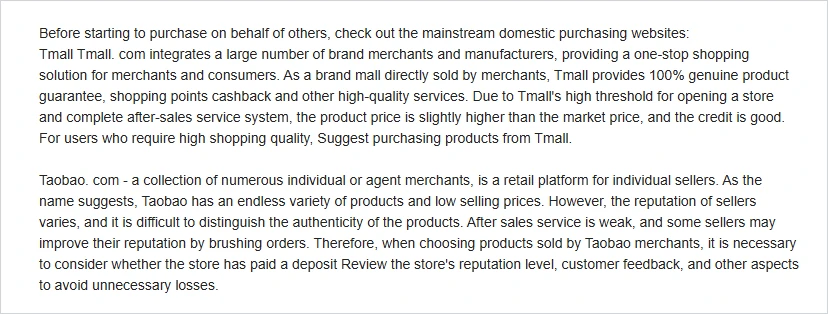
The tutorial opens by telling you to check out the mainstream domestic purchasing websites before buying on behalf of others, and then describes them one at a time. The treatment is not even, and that is what makes it useful.
Tmall gets the warm paragraph: brand merchants and manufacturers, a high threshold for opening a store, a complete aftersales system, prices slightly above market, good credit, and a direct recommendation for users who require high shopping quality. Taobao gets the careful one: individual sellers, endless variety, low prices, seller reputation that varies, weak aftersales, and the observation that some sellers improve their reputation by brushing orders.
Nobody writes that about their own biggest traffic source unless they have seen the consequences arrive at their warehouse. Read the second paragraph as what it is, which is an operator telling you in advance where its aftersales burden comes from.
Source excerpt · dated capture
Source excerpt · dated capture
Picking a size is picking a risk that nobody downstream carries
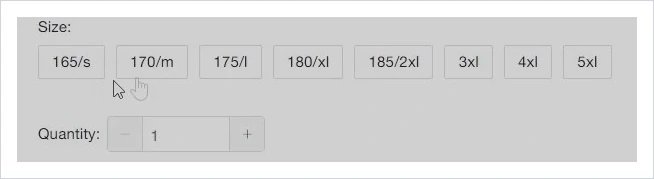
Every listing offers a row of size buttons, usually labelled with a height as well as a letter, which looks like more information than it is. The letter and the number are both chosen by the seller, and no one between that seller and your front door will compare either against the garment.
That is not an accusation; it is stated policy. Size error sits in the same excluded set as colour difference and usage effect. If the sleeve runs short, nothing failed, because nothing was being tested.
Which makes the size decision one of the small number of choices on this whole journey that is entirely yours. Find the measurement table on the listing, compare it against a garment you already own and have measured flat, and treat the size button as a label rather than as a promise.
What makes a useful spreadsheet site, and what makes a decorative one
Before the seller and before the forwarder there is the catalogue you were browsing when you found the thing, and it deserves the same suspicion as everything else on this page. Three questions separate the ones worth using from the ones built to be passed around.
Does it show you the source listing, or does it stand between you and the seller? A catalogue that hides which shop a card came from has removed the only thing you needed in order to check anything: the deposit, the reputation level, the buyer feedback, the measurement table. Second, is anything dated or even ordered? A listing that sold out two years ago looks exactly like one that went up this morning, and a catalogue that never says which is which is wasting your clicks. Third, does the page say anything at all about what happens after the click, or does it stop at the moment of enthusiasm?
That last one is the honest test, and it is the reason this site is written the way it is. A catalogue is for finding things. The fees, the inspection scope and the deadlines are what decide how the finding ends, and they are published, and almost nobody reads them until it is expensive to start.
Source excerpt · dated capture
Choosing an agent, without taking its own word for it
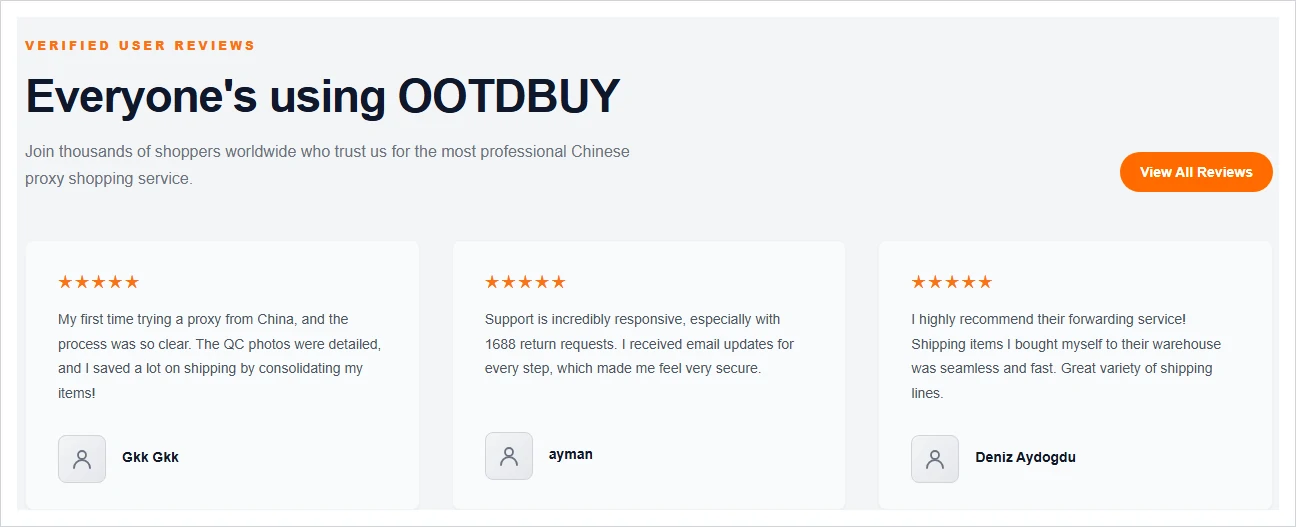
Every forwarding service publishes a wall of five star cards, and every one of those walls was assembled by the party being reviewed. That does not make the cards false. It makes them unfalsifiable, which is a different problem and a worse one for anybody trying to choose.
The things worth comparing between forwarders are all dull and all checkable without leaving the notice pages. How long is the free storage period, and what happens at the end of it. How long after signature can you still raise a problem. Is the inspection scope written down, and does it admit what it excludes. Is there a published exemption clause at all, or does the question simply not get answered anywhere.
An operator that publishes an unflattering exemption clause has told you more about itself than one that publishes a hundred testimonials. This site reads one operator that way, and the same method works on any of them.
Source excerpt · dated capture
Picking a listing: the line under the pictures is the real one
Once a seller is chosen, the listing itself has to be read, and the most informative thing on it is not in the description. It is the short disclaimer printed under the gallery, which states that the images and the description come from the source seller and separates the platform from both.
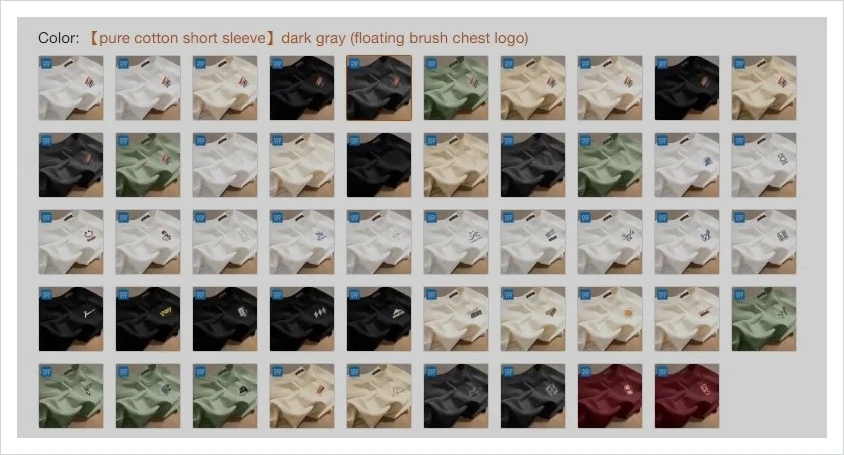
Everything above that line is marketing produced by the party with the most to gain. Everything below it is the service telling you so. Read in that order, a product page becomes much easier to handle: the photographs show what the seller wants shown, the text says what the seller wants said, and the only binding string on the page is the variant name you will end up pasting into a purchase request.
The practical checks are the ones the tutorial itself suggests for the marketplace platform. Has the store paid a deposit. What is its reputation level. What does the buyer feedback say, and does it read like feedback or like inventory. Those checks are the operator's own, not this site's.
Source excerpt · dated capture

What to look at, in the order it costs you money
Four decisions, made minutes apart, with wildly different consequences. They are listed here in the order they arrive, which is not the order of their importance.
| Decision | What actually decides it |
|---|---|
| Which catalogue you browse | Whether it shows you the source listing rather than standing between you and it. A catalogue that hides the seller is selling you something else |
| Which platform the listing sits on | The tutorial recommends the brand mall for shoppers who want quality, and lists specific concerns about the individual seller marketplace |
| Which seller | Deposit paid, reputation level, and feedback that reads like people rather than like volume |
| Which forwarder | Storage period, feedback deadline, inspection scope, and whether an exemption clause exists in writing at all |
The middle two rows paraphrase the official tutorial. The outer two are this site's own reading and are argued above.
For the warehouse scope in the final row, read the inspection notice and its source excerpt.
The operator names the specific failure mode
One clause in that tutorial paragraph does more work than everything else on this page. It is a plain description of how a bad listing acquires a good reputation, published by the company that will be asked to forward the resulting parcel.
Some sellers may improve their reputation by brushing orders.
Official tutorial, on the individual seller marketplace, read 2026-09-03
A store with thousands of sales and nothing else going for it is exactly the pattern that sentence describes. The defence is the same one the tutorial gives: look at the deposit and the feedback rather than the number. And once the order is placed, the clauses take over, which is a worse place to be making decisions.
The same tutorial excerpt is shown in the platform comparison above.
When the answer is a different service entirely
A page about choosing is worthless if it cannot say when to choose something else, so here it is.
If what you want is a single item, delivered quickly, with a local returns address and somebody to complain to in your own legal system, a forwarding agent is the wrong tool and the notices on this site explain why in detail. The returns route goes back through a warehouse in another country, the aftersale depends on a seller's approval, and the deadlines are counted in days rather than weeks.
A forwarder earns its keep on the other shape of order: several things, from several sellers, consolidated into one box, where the freight per item is what makes the whole thing work. If your order does not look like that, the honest recommendation is to buy locally and keep the consumer protection that comes with it.
If it does look like that, the rest of this site is the part worth reading before you start. Begin with the checks page, because it governs the moment everybody assumes is covered.
Source excerpt · dated capture